Hermens HJ, Freriks B, Disselhorst-Klug C, Rau G. Development of recommendations for SEMG sensors and sensor placement procedures. J Electromyogr Kinesiol. 2000;10(5):361-74.
Print-ready for the lab or clinic: 79 pages of protocols (SENIAM + peer-reviewed), plus the SENIAM table, a placement checklist and a sensor comparison sheet as A4 sheets.
Anatomy & Function
The M. Biceps Brachii (Biceps Brachii) is a muscle of the upper arm region. It is responsible for elbow flexion, forearm supination, shoulder anteversion. This muscle is one of 26 with official SENIAM-recommended surface EMG electrode placement. This page documents the exact electrode position, anatomical attachments and a standardized test movement based on Hermens et al. (2000).
Innervation after Perotto AO, Anatomical Guide for the Electromyographer, 5th ed. 2011 — an anatomical reference, not an electrode placement recommendation.
Clinical applications (SENIAM)
Post-trauma elbow rehabilitation
Biceps/triceps tendinitis monitoring
Workplace ergonomics assessment
Test Movement
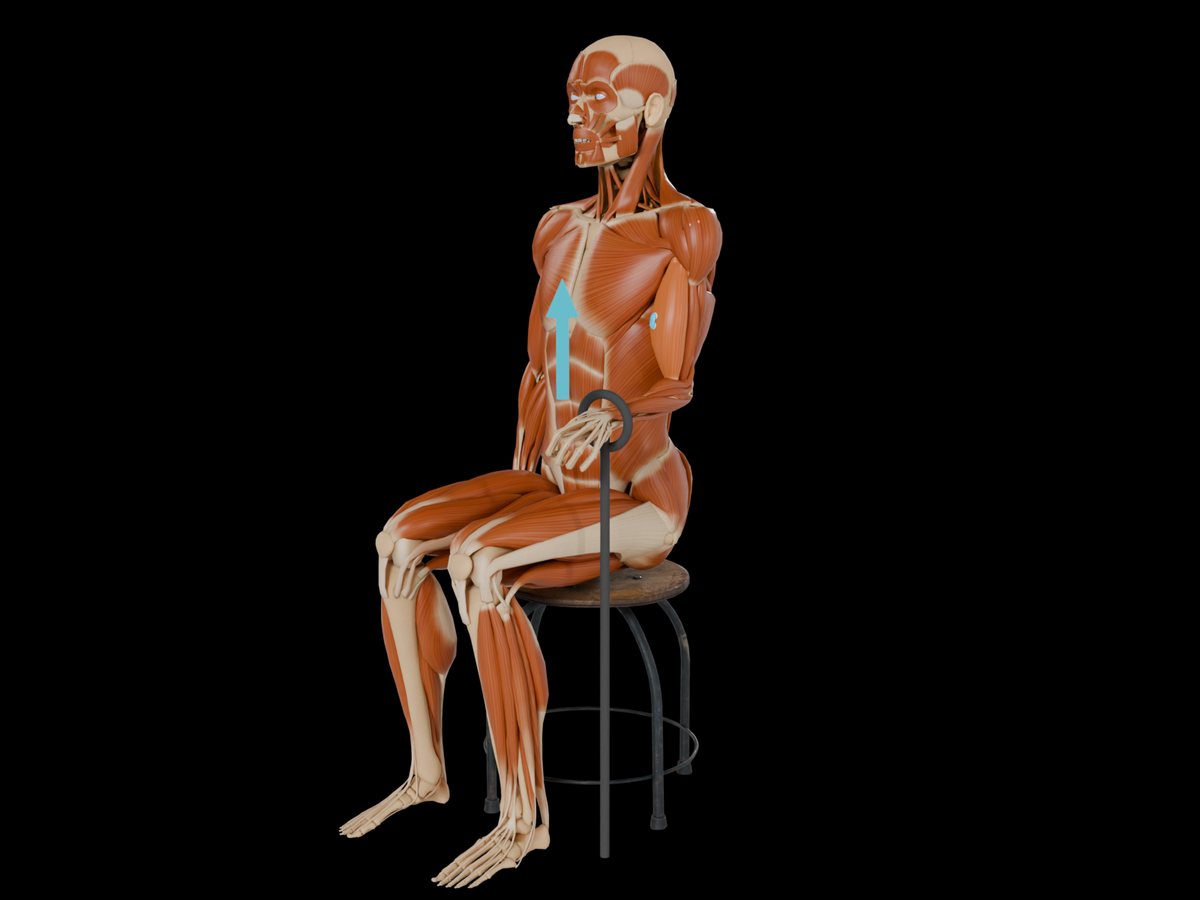
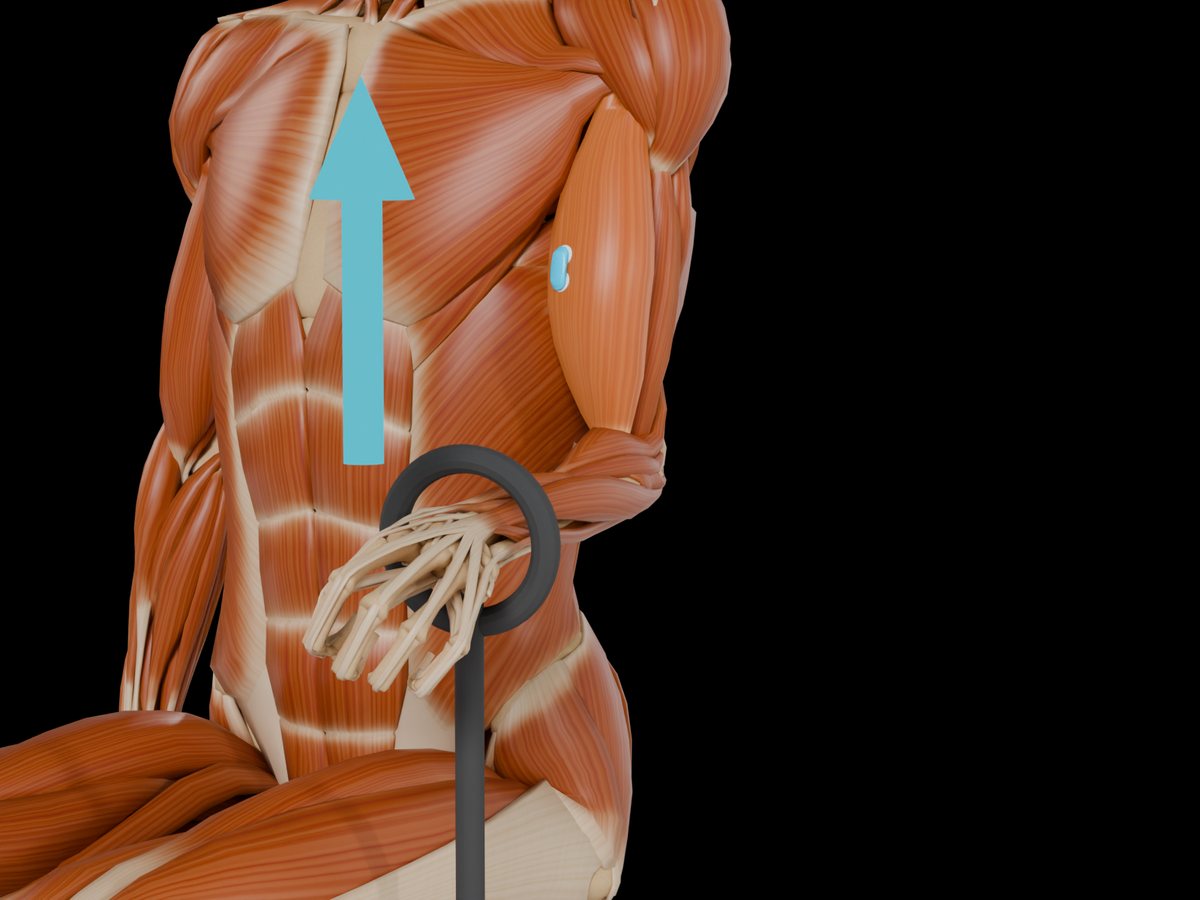
Elbow flexion against resistance with supinated forearm
Illustration shows the left side; the set-up is mirrored for the right side.
MVC reference test (Konrad 2005)
Position
Seated or kneeling in front of a bench, elbow at about 90°, forearm supinated.
Fixation
Very stable fixation of elbow and trunk; the upper arm stays vertical at the side.
Resistance
Rigid resistance under the wrist (strap to the floor, bar or manual), elbow flexion against it.
Control exercise
Use the latissimus dorsi test as a control exercise.
Without elbow and trunk fixation the effort leaks into the shoulder and the biceps never reaches its maximum.
Konrad P. The ABC of EMG. Noraxon; 2005, p. 31. Konrad describes this test at group level; it applies to all muscles of the group. · Why and how to normalise to MVC
Measure M. Biceps Brachii activity live
The electrode is placed — what next? easyEMG visualises muscle activity in real time, with SENIAM-compliant placement guidance, up to 4 channels at once and biofeedback training right afterwards.
In rehabilitation, the Biceps Brachii is typically recorded to track progress and retrain activation.
Where do I place the EMG electrode on the M. Biceps Brachii?
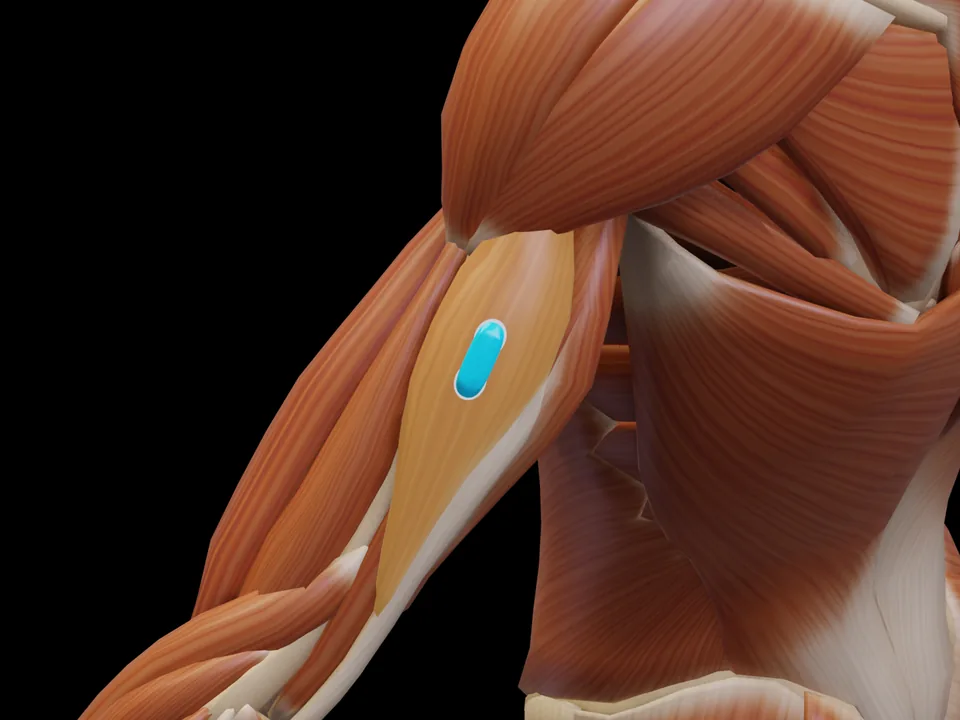
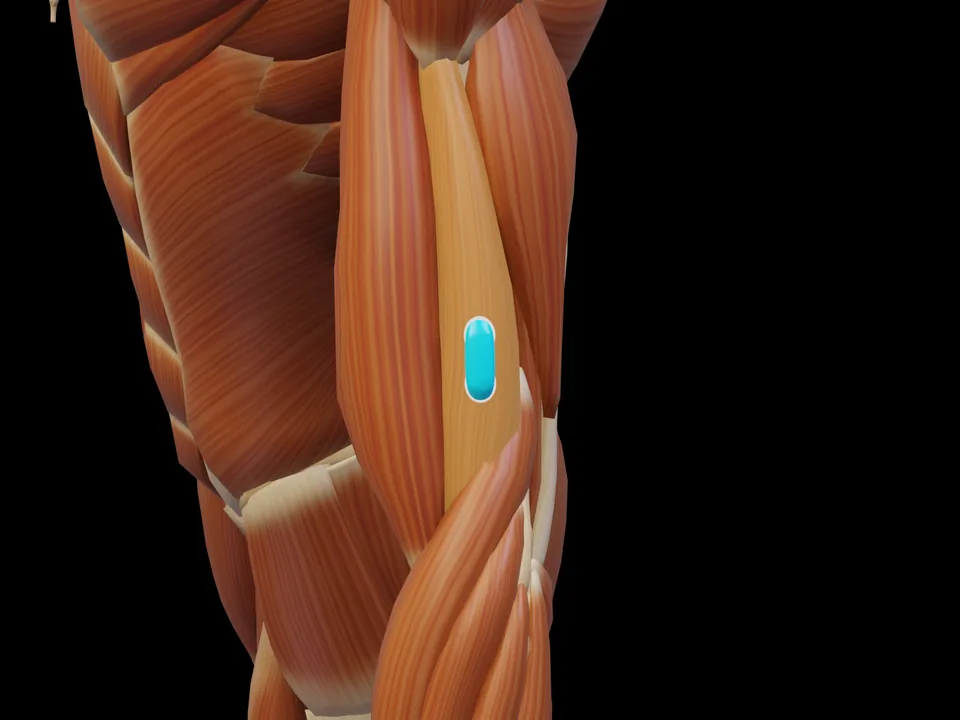
1/3 on line between cubital fossa and acromion. Orientation: Parallel to line cubital fossa–acromion. Based on the official SENIAM recommendations (Hermens et al. 2000).
Which test movement activates the M. Biceps Brachii?
Elbow flexion against resistance with supinated forearm. This movement is part of the SENIAM protocol for standardized contraction verification.
Is the M. Biceps Brachii a SENIAM-recommended muscle?
Yes. The M. Biceps Brachii is one of 26 muscles for which the SENIAM project has published official surface EMG electrode placement recommendations.
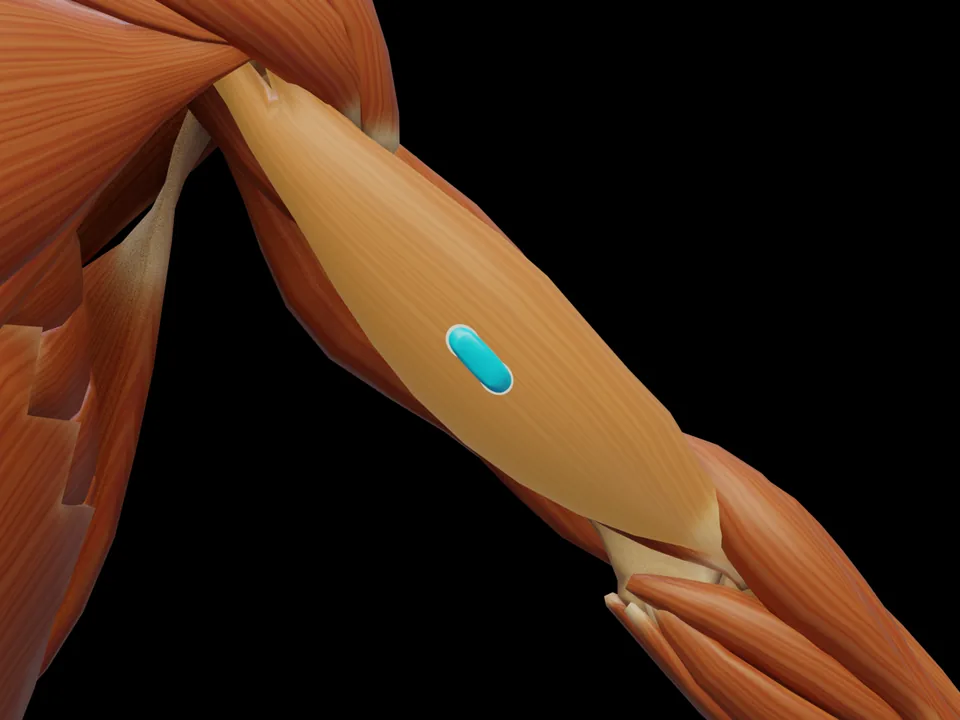 Preview — open the 3D viewer to rotate the model and check neighbouring muscles.
View in 3D Viewer
Preview — open the 3D viewer to rotate the model and check neighbouring muscles.
View in 3D Viewer