Can I Measure This Muscle With Surface EMG?
Type a muscle and get a one-line answer: whether surface EMG can record it at all, and if so, how selectively — specific (predominantly this muscle), quasi-specific (a group recording, Cram's grade) or surface-recordable without a separate grade — whether no surface position is documented for it, or whether it needs fine-wire EMG because it lies under another muscle. The check covers the 54 muscle pairs of the EMG Guide catalogue plus 14 muscles that are deliberately not in it, with the crosstalk neighbours and a link to the muscle page and the 3D viewer.
The check
How to read the five answers
- Specific. A 20-mm bipolar pair at the documented SENIAM or literature position records predominantly this muscle (Cram's grade). Statements about the single muscle — side-to-side, before/after, % MVC — are legitimate, provided placement and skin preparation follow the placement guide.
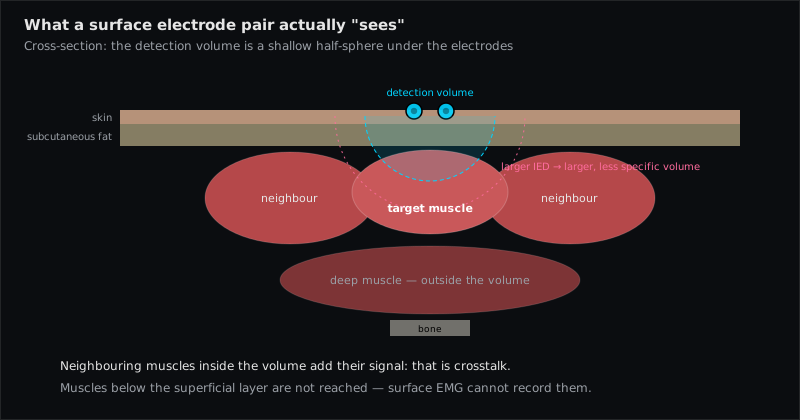
- Quasi-specific. The muscle cannot be separated from its neighbours with surface electrodes (forearm flexors, medial hamstrings, hip adductors …). The recording is valid, but interpret it at group level and do not compare amplitudes between two members of the same group. Background: specific, quasi-specific, general.
- Surface muscle (not graded). In the catalogue with a SENIAM or peer-reviewed position, but Cram's atlas has no separate site for it — so no specificity grade is stated. Treat it as specific if it is large and well separated, as quasi-specific if it has close neighbours; the muscle page lists them.
- No documented surface position. The muscle is in the catalogue, but neither SENIAM nor a peer-reviewed source documents where to place surface electrodes over it — so the muscle page gives no position, and a surface signal at that spot cannot be attributed to this muscle with confidence.
- Fine-wire only. The muscle lies under another muscle; a surface pair over it records the covering muscle, whatever the label says. The check names what you would actually record and the accessible neighbour or synergist. Why: which muscles cannot be measured with surface EMG.
What the check does not do
It does not replace the functional test. Cram's rule stands for every "yes": the trace must respond to the muscle's own action and stay quiet when the neighbours contract. And it does not know your patient — subcutaneous fat, muscle size and how tightly the neighbours are packed vary between people; a specific site on one person can be quasi-specific on another.
Muscles referenced in this article
From placement to measurement
EMG Guide shows where the electrodes go. easyEMG with PicoBlue sensors visualises the signal live afterwards — SENIAM-conform, in real time, with a signal check on screen.
Frequently asked questions
The muscle I typed is not found — does that mean it cannot be measured?
No — it means it is not in the EMG Guide catalogue or the fine-wire list. Try the Latin or English name, or a synonym (e.g. "upper trapezius" for trapezius descendens). Muscles that are genuinely not surface-recordable are in the list and return "fine-wire only".
Where do the grades come from?
From Cram's electrode atlas (Criswell 2011, Part III), which grades every site as specific or quasi-specific, mapped to the EMG Guide catalogue via the recording notes on each muscle page. SENIAM muscles without a Cram's site are shown as "surface muscle".
Can I cite this?
Yes: the sources are listed below, and each answer links to the muscle page with its position, orientation, test movement and source. For the fine-wire entries the primary literature (Perotto, Castelein et al., Boettcher et al.) is given in the linked article.
Sources
- Criswell E. Cram's Introduction to Surface Electromyography. 2nd ed. 2011 — Part III electrode atlas (placement grades specific / quasi-specific).
- Hermens HJ et al. SENIAM recommendations. J Electromyogr Kinesiol. 2000;10:361–374.
- Perotto AO. Anatomical Guide for the Electromyographer. 5th ed. 2011.
- Castelein B et al. Man Ther. 2016;22:158–164 (fine-wire for levator scapulae, rhomboids, pectoralis minor).
- Boettcher CE et al. J Orthop Res. 2008;26:1591–1597 (intramuscular supraspinatus).
- EMG Guide muscle catalogue and recording notes (api/muscles.json, api/placement-notes.json).
Read next
EMG Electrode Placement — The Practical Guide
How to place surface EMG electrodes correctly — SENIAM rules, skin prep, 20 mm spacing, fibre direction, reference electrode, signal check and common mistakes.
Specific, Quasi-Specific, General — The Three Types of Surface EMG Placement
Why there is no single correct electrode position — Cram's three placement types, what each records, where SENIAM fits, and what it means for interpretation.
Which Muscles Cannot Be Measured With Surface EMG — and Why
Iliopsoas, supraspinatus, rhomboids, levator scapulae … why surface electrodes cannot record deep or covered muscles, what you record instead, and the alternatives.
All articles →