Electrode Placement (SENIAM)
Proximal 1/6 on line ASIS-lateral femoral condyle
Orientation: Parallel to line ASIS-lateral femoral condyle
Source:
SENIAM (Hermens 2000) ↗
Hermens HJ, Freriks B, Disselhorst-Klug C, Rau G. Development of recommendations for SEMG sensors and sensor placement procedures. J Electromyogr Kinesiol. 2000;10(5):361-74.
Recording notes per Criswell 2011, site „Tensor Fasciae Latae“, p. 357
- Placement type
- Specific site The signal originates predominantly from this muscle.
- Signal check
- Standing on one leg; abduction of the leg with internal rotation; walking.
Based on SENIAM recommendations (Hermens et al. 2000). Not an official SENIAM product. See all references →
· How electrodes are placed (guide)
· Glossary
All 48 muscle protocols as a PDF — free
Print-ready for the lab or clinic: 84 pages of protocols (SENIAM + peer-reviewed), plus the SENIAM table, a placement checklist and a sensor comparison sheet as A4 sheets.
Anatomy
Origin
Anterior superior iliac spine (ASIS), iliac crest (anterior section)
Insertion
Iliotibial tract -> lateral tibial condyle (Gerdy's tubercle)
Innervation
Superior gluteal nerve, L4–S1
Test Movement
Hip flexion with abduction and internal rotation against resistance
Clinical Applications
Common use cases for surface EMG measurement of the M. Tensor Fasciae Latae:
- Hip rehabilitation after arthroplasty
- Gluteus medius weakness in runners
- Trendelenburg sign EMG analysis
Measure M. Tensor Fasciae Latae activity live
The electrode is placed — what next? easyEMG visualises muscle activity in real time, with SENIAM-compliant placement guidance, up to 4 channels at once and biofeedback training right afterwards.
In rehabilitation, the Tensor Fasciae Latae is typically recorded to track progress and retrain activation.
Frequently Asked Questions
Where do I place the EMG electrode on the M. Tensor Fasciae Latae?
Proximal 1/6 on line ASIS-lateral femoral condyle. Orientation: Parallel to line ASIS-lateral femoral condyle. Based on the official SENIAM recommendations (Hermens et al. 2000).
Which test movement activates the M. Tensor Fasciae Latae?
Hip flexion with abduction and internal rotation against resistance. This movement is part of the SENIAM protocol for standardized contraction verification.
Is the M. Tensor Fasciae Latae a SENIAM-recommended muscle?
Yes. The M. Tensor Fasciae Latae is one of 26 muscles for which the SENIAM project has published official surface EMG electrode placement recommendations.
Related Muscles in This Region
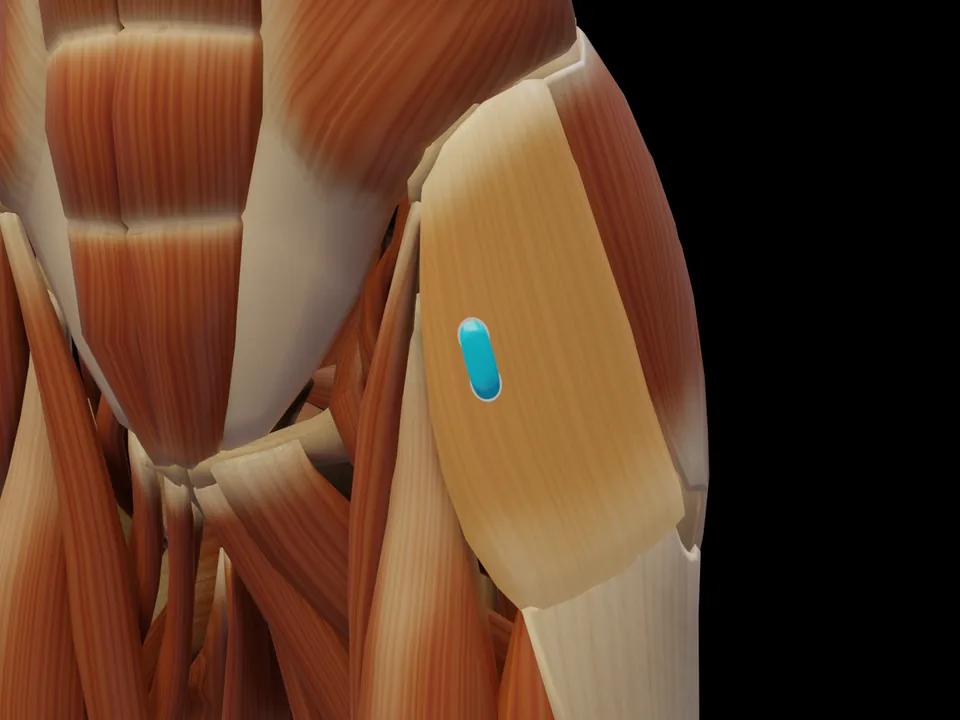 Preview — open the 3D viewer to rotate the model and check neighbouring muscles.
View in 3D Viewer
Preview — open the 3D viewer to rotate the model and check neighbouring muscles.
View in 3D Viewer